Denoise
Denoising is an image processing technique used to remove unwanted corruption of acquired images by noise, which is inherently present in the image formation process of a microscope. Its origin lies in the stochastic nature of photon emission from light sources and dyes, as well as in the conversion of the measured photon flux into digital intensity values.
Denoise.ai
A deep learning-based solution that usually delivers the best results across all different modalities and imaging conditions. The network is fast and has been trained on a diverse set of images acquired by Nikon confocal as well as camera-based systems.
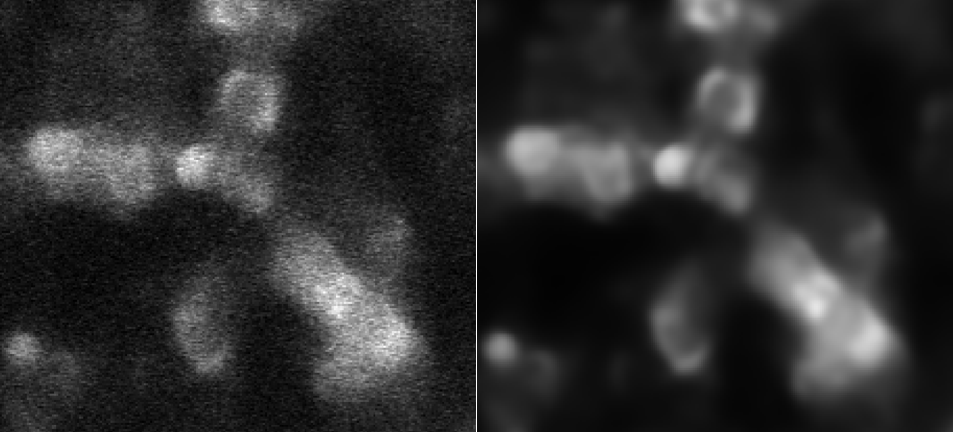
However, denoise.ai is not suitable for images with very high noise levels. In extreme cases, the network may misinterpret clusters of noisy pixels as obscured signal and introduce hallucinated structures – that is, features that do not exist in the sample. For such images, deconvolution may yield more accurate reconstructions.
It is difficult to quantify what noise level is considered too high. If in doubt, it is good practice to first validate denoise.ai on a few representative images against high-quality ground truth before using it routinely on large data sets.
Legacy denoising algorithms
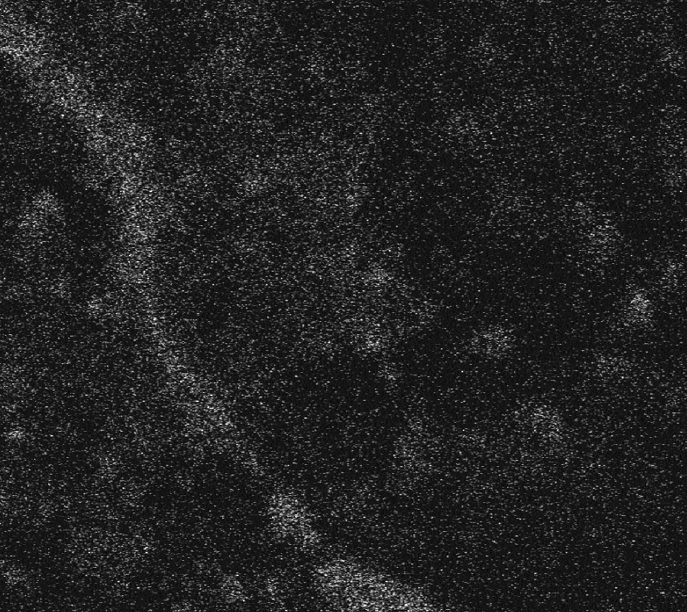
Mainly for compatibility reasons, we also offer several non-deep learning-based methods (see Denoising group in Image Processing). Their performance is worse than denoise.ai in most scenarios, but they theoretically offer better explainability which is preferred by some users.