AI Workflows
Speed up CellposeSAM with Segment Objects.ai
This workflow shows you how to:
- use Cellpose SAM to detect nuclei in 3D;
- train Segment Objects.ai on the detected nuclei; and
- run the trained model on multiple datasets approximately 18 times faster than CellposeSAM.
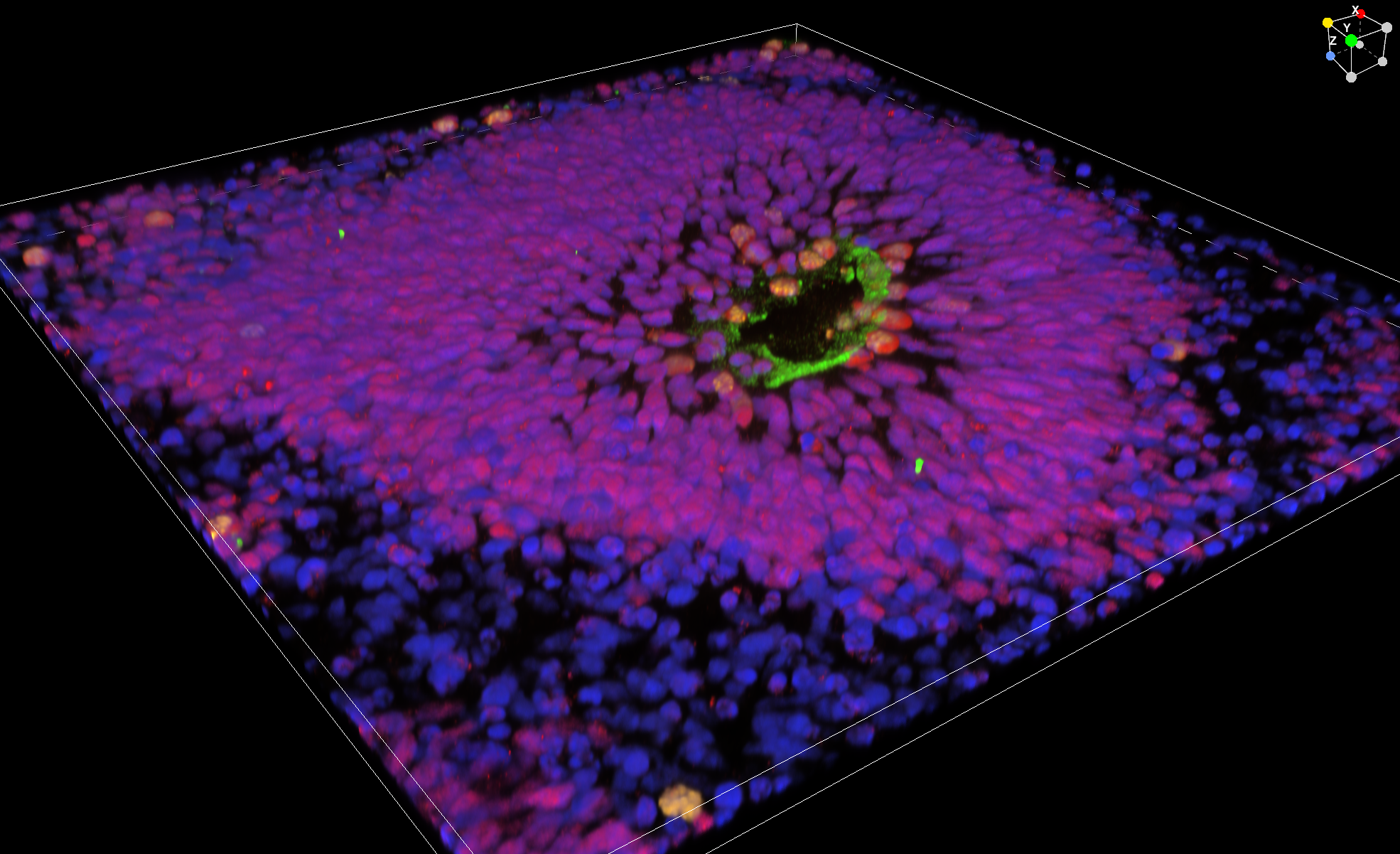
The test image is a 3D image of an organoid captured in the DAPI, FITC, TRITC, and Cy5 channels. It measures 2,392 × 2,392 × 27 voxels (approximately 300 MB per channel).
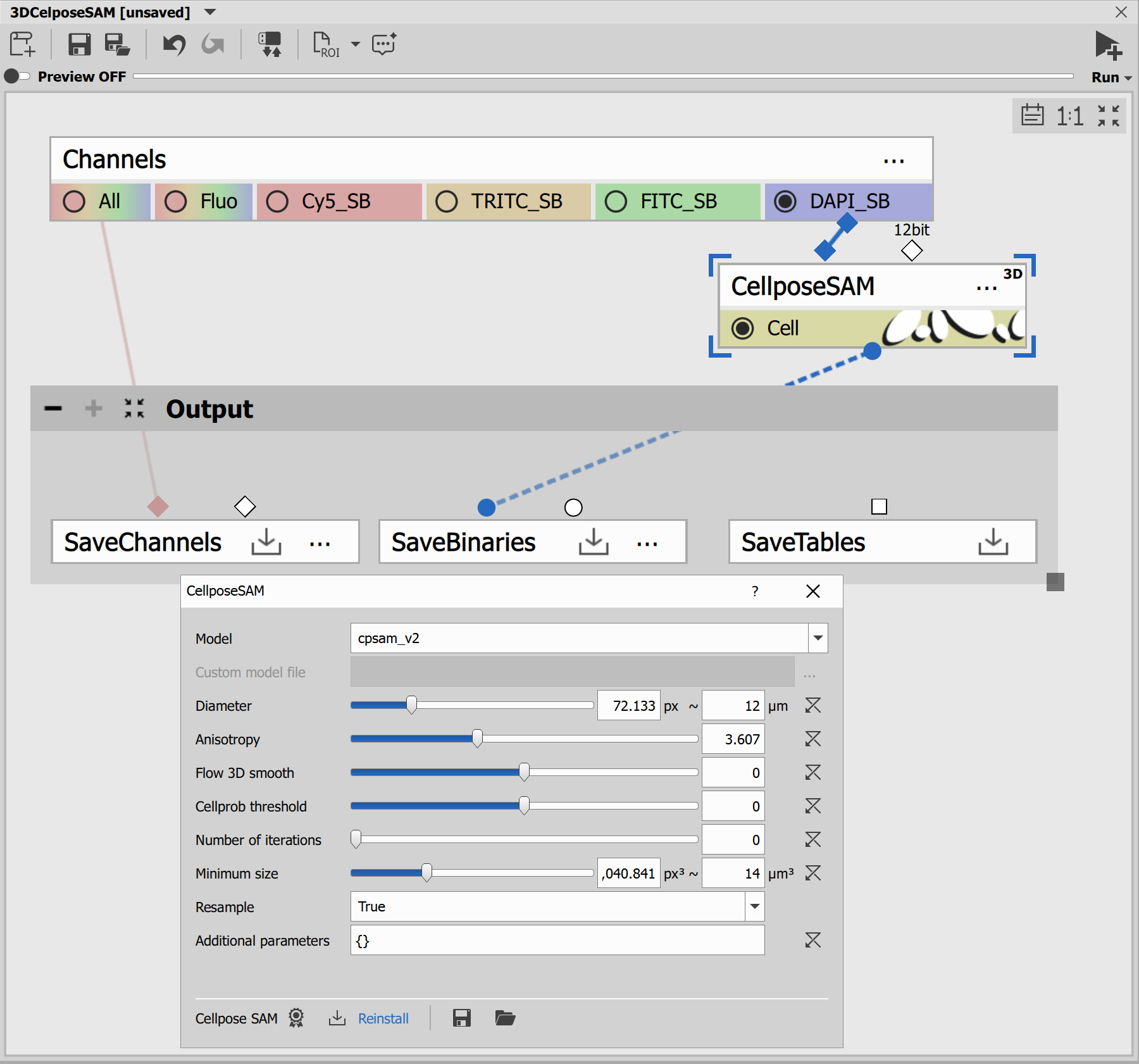
1. Use CellposeSAM detection as the ground truth
The CellposeSAM 3D node segments the nuclei well with its default settings. It is connected to the DAPI_SB channel. However, generating the preview takes several minutes.
The result is worth the wait.
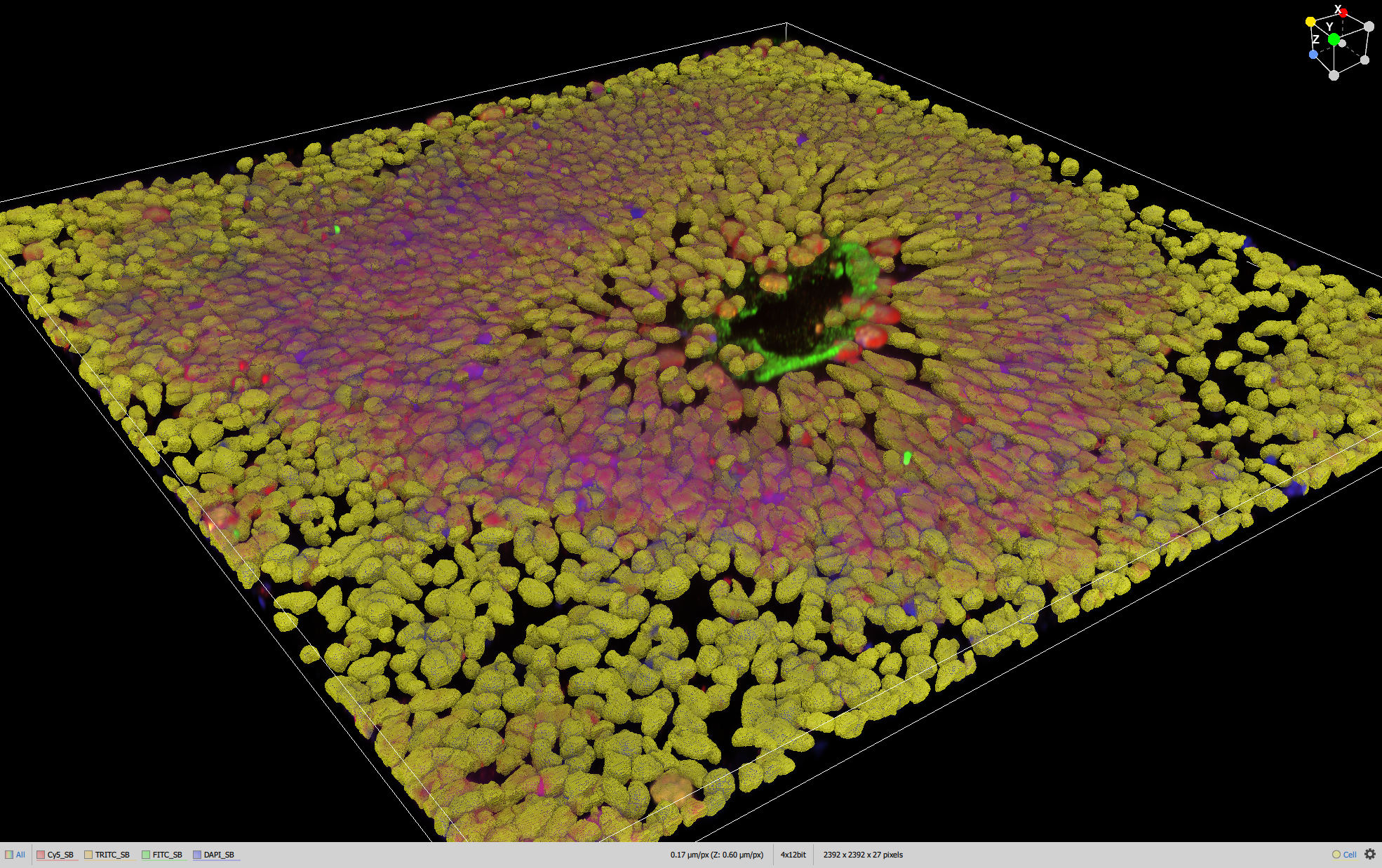
If you need to segment and analyze several similar images, you can reduce the processing time by training and using a simpler model.
Save and run the recipe to generate the image and binary layer required for training.
On an NVIDIA RTX A4000 with 16 GB of VRAM, this process takes approximately 585 seconds (9 minutes 45 seconds).
2. Train Segment Objects.ai
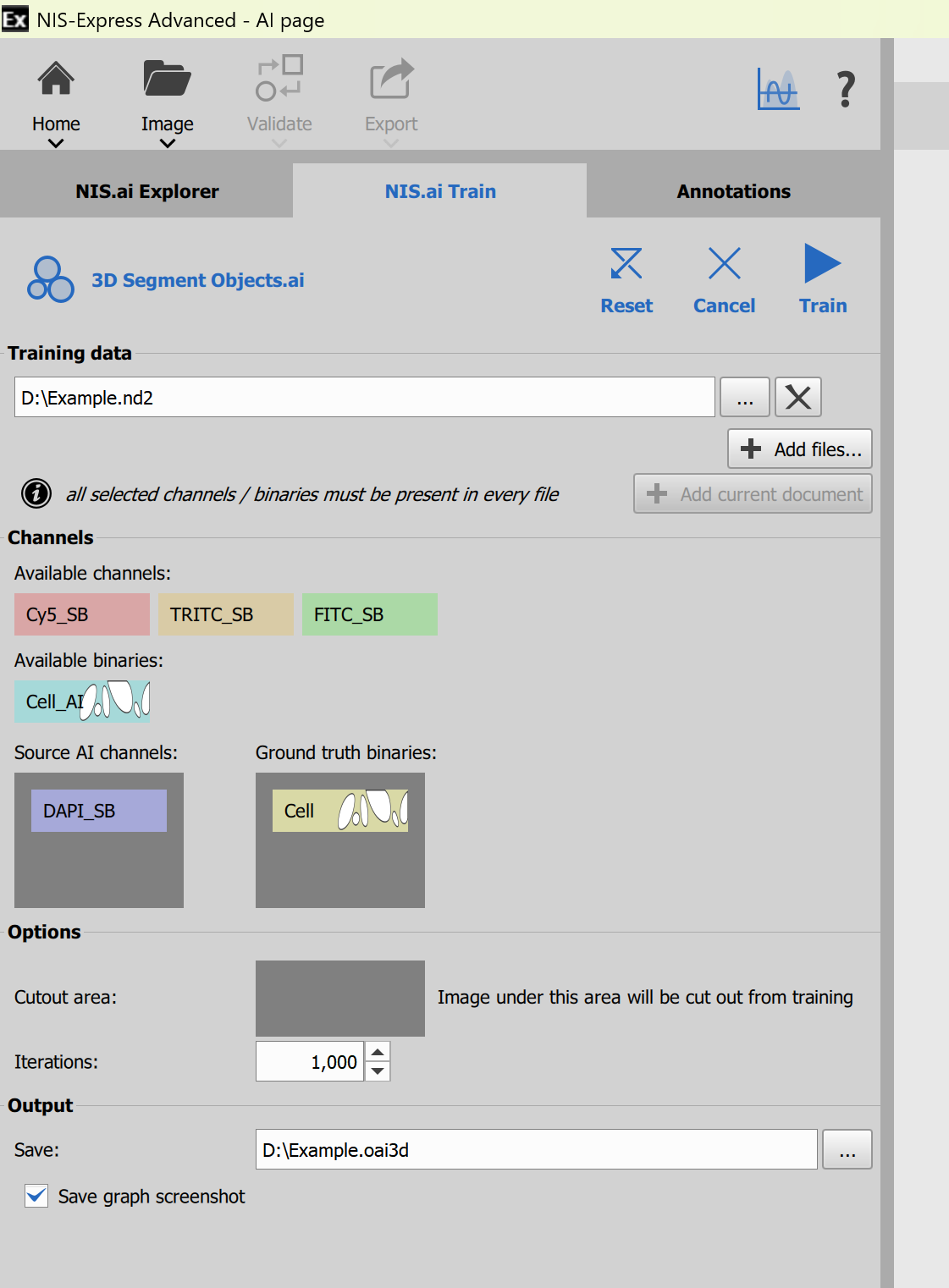
Set up the training by selecting 3D Segment Objects.ai.
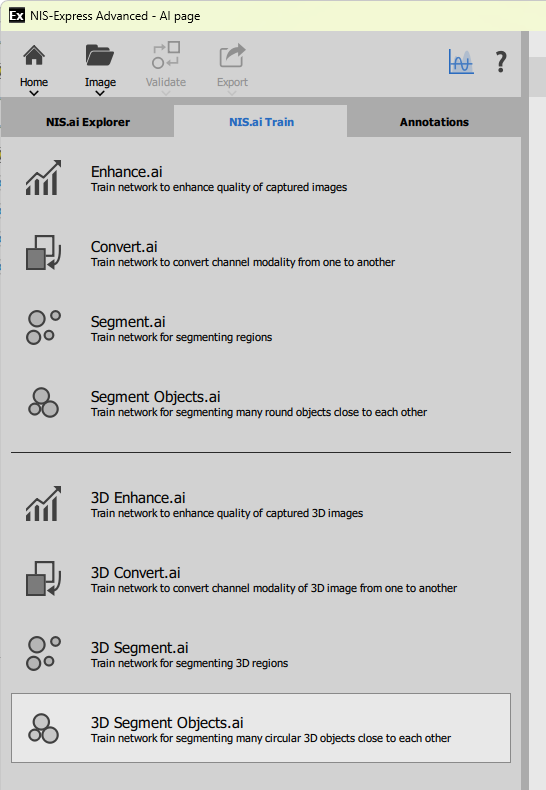
Configure the training as follows:
- Select the
.nd2file that you processed with CellposeSAM. - Drag
DAPI_SBto Source AI channels. - Drag
Cellto Ground truth binaries. - Select a location for the output
.oai3dfile and make a note of it.
Finally, click Train to start the training.
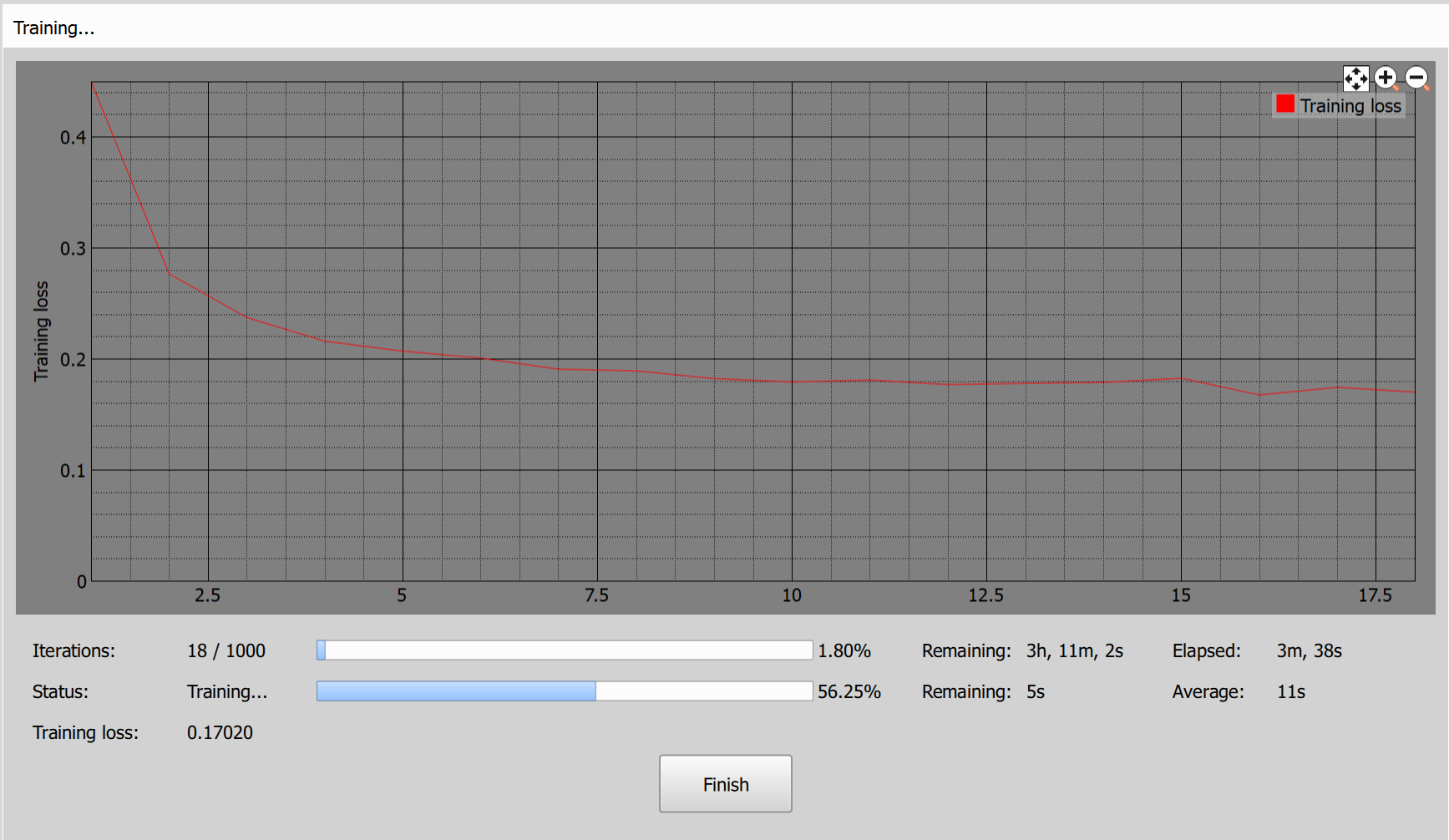
Stop the training when the loss function reaches a plateau. This should take a few minutes. In this example, we stopped the training after 3 minutes 28 seconds.
3. Replace CellposeSAM with Segment Objects.ai
In the new recipe, replace CellposeSAM 3D with Segment Objects.ai 3D. The only parameter you need to set is the location of the .oai3d file created in the previous step.
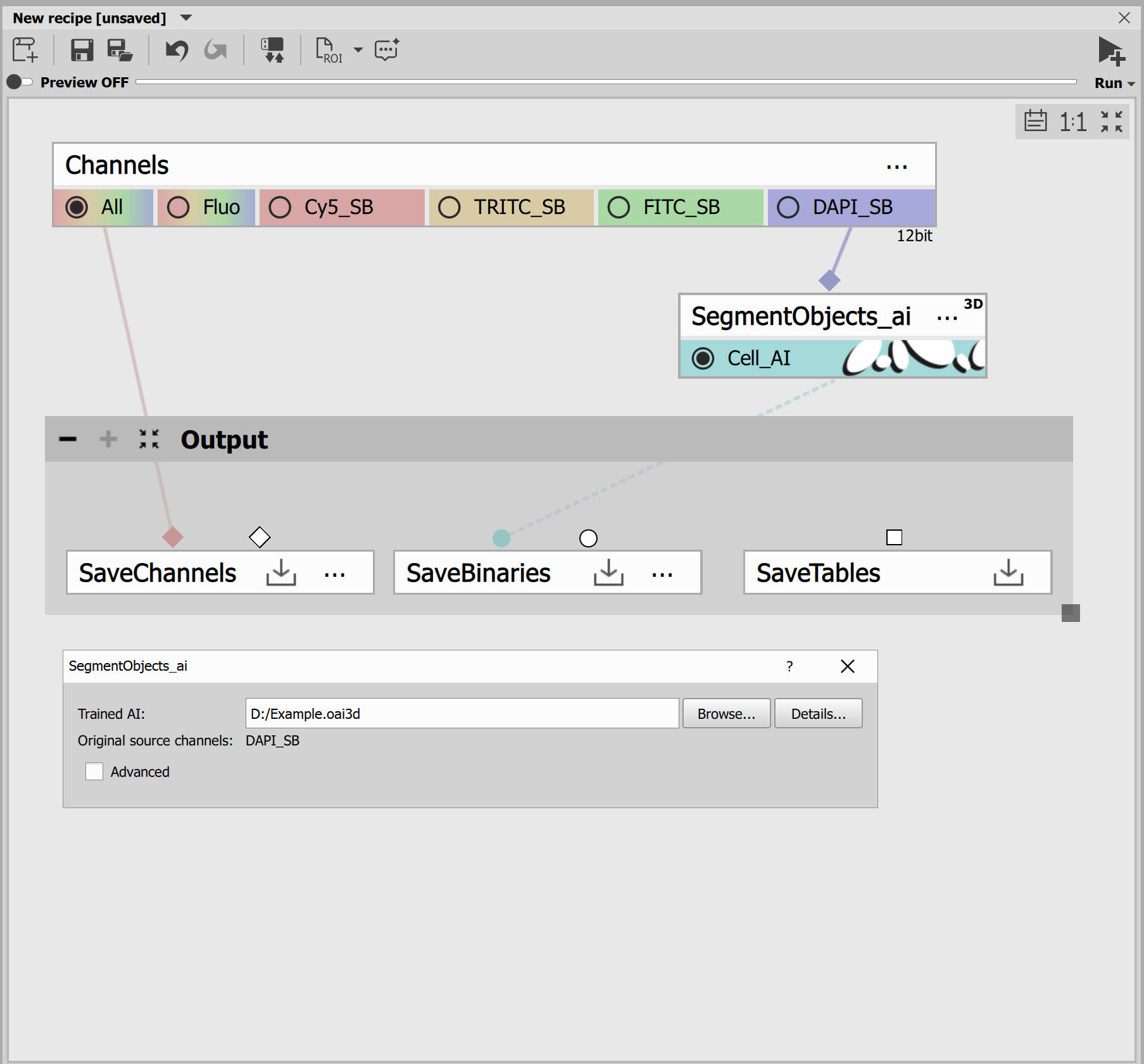
The resulting segmentation looks very similar, but the recipe takes only 32 seconds to run—approximately 18 times faster than the CellposeSAM version.
Accuracy Evaluation
Although the segmentation looks good visually it is useful to have a quantitative confirmation.
To do that use Object Segmentation Accuracy node.
Copy the prompt below system prompt after:
## Task provided by userCreate a Python script that calculates 3D segmentation accuracy. The inputs are two 3D binary layers, and the accuracy should be calculated as follows:
Object Segmentation Accuracy
Calculates the average precision to evaluate AI performance on objects. This node has two inputs - GT (Ground Truth) and Pred (Prediction). It compares the ground truth binary layer (A) and predicted binary layer (B) generated by segmentation using AI.
This node calculates the given metrics directly on objects. The metrics it computes (TP, FP, FN) are expressed as the number of objects.
- true positives (TP) matched correctly,
- false positives (FP) incorrectly segmented objects and
- false negatives (FN) incorrectly missed objects.
Based on these numbers it calculates:
- precision = TP / (TP + FP),
- recall = TP / (TP + FN) and
- F1 = 2 x precision x recall / (precision + recall)
I need the accuracy to be calculated on complete 3D objects, not separately for individual Z-slices.import limnode
import numpy as np
import pandas as pd
from scipy import ndimage
from scipy.sparse import csr_matrix
from scipy.sparse.csgraph import maximum_bipartite_matching
"""
3D object segmentation accuracy.
inp[0] = Ground Truth Binary
inp[1] = Prediction Binary
out[0] = Table
The complete input volume (Z, Y, X, C) is processed as one 3D volume.
Connected components therefore extend across Z slices and are NOT evaluated
slice-by-slice.
Objects are matched one-to-one when their 3D IoU >= IOU_THRESHOLD.
"""
IOU_THRESHOLD = 0.5
def output(
inp: limnode.InDefTuple,
out: limnode.OutDefTuple,
par: limnode.UserParTuple,
) -> None:
if len(inp) < 2:
raise ValueError("Two Binary inputs are required: GT and Pred.")
if not isinstance(inp[0], limnode.InputBinaryDef):
raise TypeError("inp[0] must be a Binary input (Ground Truth).")
if not isinstance(inp[1], limnode.InputBinaryDef):
raise TypeError("inp[1] must be a Binary input (Prediction).")
if len(out) < 1 or not isinstance(out[0], limnode.OutputTableDef):
raise TypeError("out[0] must be a Table output.")
(
out[0]
.makeEmpty("3D Object Segmentation Accuracy")
.withLoopCols()
.withIntCol("TP")
.withIntCol("FP")
.withIntCol("FN")
.withFloatCol("Precision")
.withFloatCol("Recall")
.withFloatCol("F1")
)
def build(
par: limnode.UserParTuple,
loops: limnode.LoopDefs,
) -> limnode.Program | None:
# No reduction/multi-pass program is needed.
# Each run() invocation receives the volume as (Z, Y, X, C).
return None
def run(
inp: limnode.InDataTuple,
out: limnode.OutDataTuple,
par: limnode.UserParTuple,
ctx: limnode.RunContext,
) -> None:
if len(inp) < 2:
raise ValueError("Two Binary inputs are required: GT and Pred.")
if not isinstance(inp[0], limnode.InputBinaryData):
raise TypeError("inp[0] must be Binary data (Ground Truth).")
if not isinstance(inp[1], limnode.InputBinaryData):
raise TypeError("inp[1] must be Binary data (Prediction).")
if len(out) < 1 or not isinstance(out[0], limnode.OutputTableData):
raise TypeError("out[0] must be Table data.")
if ctx.shouldAbort:
return
gt_data = np.asarray(inp[0].data)
pred_data = np.asarray(inp[1].data)
if gt_data.shape != pred_data.shape:
raise ValueError(
"GT and Pred must have identical shapes; "
f"got {gt_data.shape} and {pred_data.shape}."
)
if gt_data.ndim != 4:
raise ValueError(
"Binary inputs must have shape (Z, Y, X, C)."
)
# Convert arbitrary binary bit depth to Boolean foreground.
gt_mask = np.any(gt_data != 0, axis=3)
pred_mask = np.any(pred_data != 0, axis=3)
# 26-connectivity in a true 3D volume.
structure = ndimage.generate_binary_structure(3, 3)
gt_labels, n_gt = ndimage.label(
gt_mask,
structure=structure,
)
if ctx.shouldAbort:
return
pred_labels, n_pred = ndimage.label(
pred_mask,
structure=structure,
)
if ctx.shouldAbort:
return
tp = 0
if n_gt > 0 and n_pred > 0:
gt_sizes = np.bincount(
gt_labels.ravel(),
minlength=n_gt + 1,
).astype(np.int64, copy=False)
pred_sizes = np.bincount(
pred_labels.ravel(),
minlength=n_pred + 1,
).astype(np.int64, copy=False)
overlap_mask = (gt_labels > 0) & (pred_labels > 0)
if np.any(overlap_mask):
gt_ids_overlap = gt_labels[overlap_mask].astype(
np.int64,
copy=False,
)
pred_ids_overlap = pred_labels[overlap_mask].astype(
np.int64,
copy=False,
)
base = np.int64(n_pred + 1)
pair_codes = gt_ids_overlap * base + pred_ids_overlap
unique_codes, intersections = np.unique(
pair_codes,
return_counts=True,
)
gt_ids = unique_codes // base
pred_ids = unique_codes % base
unions = (
gt_sizes[gt_ids]
+ pred_sizes[pred_ids]
- intersections
)
iou = (
intersections.astype(np.float64)
/ unions.astype(np.float64)
)
valid = iou >= IOU_THRESHOLD
if np.any(valid):
# Convert natural labels 1..N to sparse-matrix indices 0..N-1.
rows = gt_ids[valid] - 1
cols = pred_ids[valid] - 1
graph = csr_matrix(
(
np.ones(
np.count_nonzero(valid),
dtype=np.uint8,
),
(rows, cols),
),
shape=(n_gt, n_pred),
)
# Maximum one-to-one matching.
matching = maximum_bipartite_matching(
graph,
perm_type="column",
)
tp = int(np.count_nonzero(matching >= 0))
fp = int(n_pred - tp)
fn = int(n_gt - tp)
precision = (
float(tp / (tp + fp))
if (tp + fp) > 0
else 0.0
)
recall = (
float(tp / (tp + fn))
if (tp + fn) > 0
else 0.0
)
f1 = (
float(
2.0 * precision * recall
/ (precision + recall)
)
if (precision + recall) > 0.0
else 0.0
)
result = pd.DataFrame(
{
"TP": [tp],
"FP": [fp],
"FN": [fn],
"Precision": [precision],
"Recall": [recall],
"F1": [f1],
}
)
out[0].withDataFrame(
result,
[
"TP",
"FP",
"FN",
"Precision",
"Recall",
"F1",
],
)
if __name__ == '__main__':
from limnode import print
limnode.child_main(run, output, build)This is the recipe:
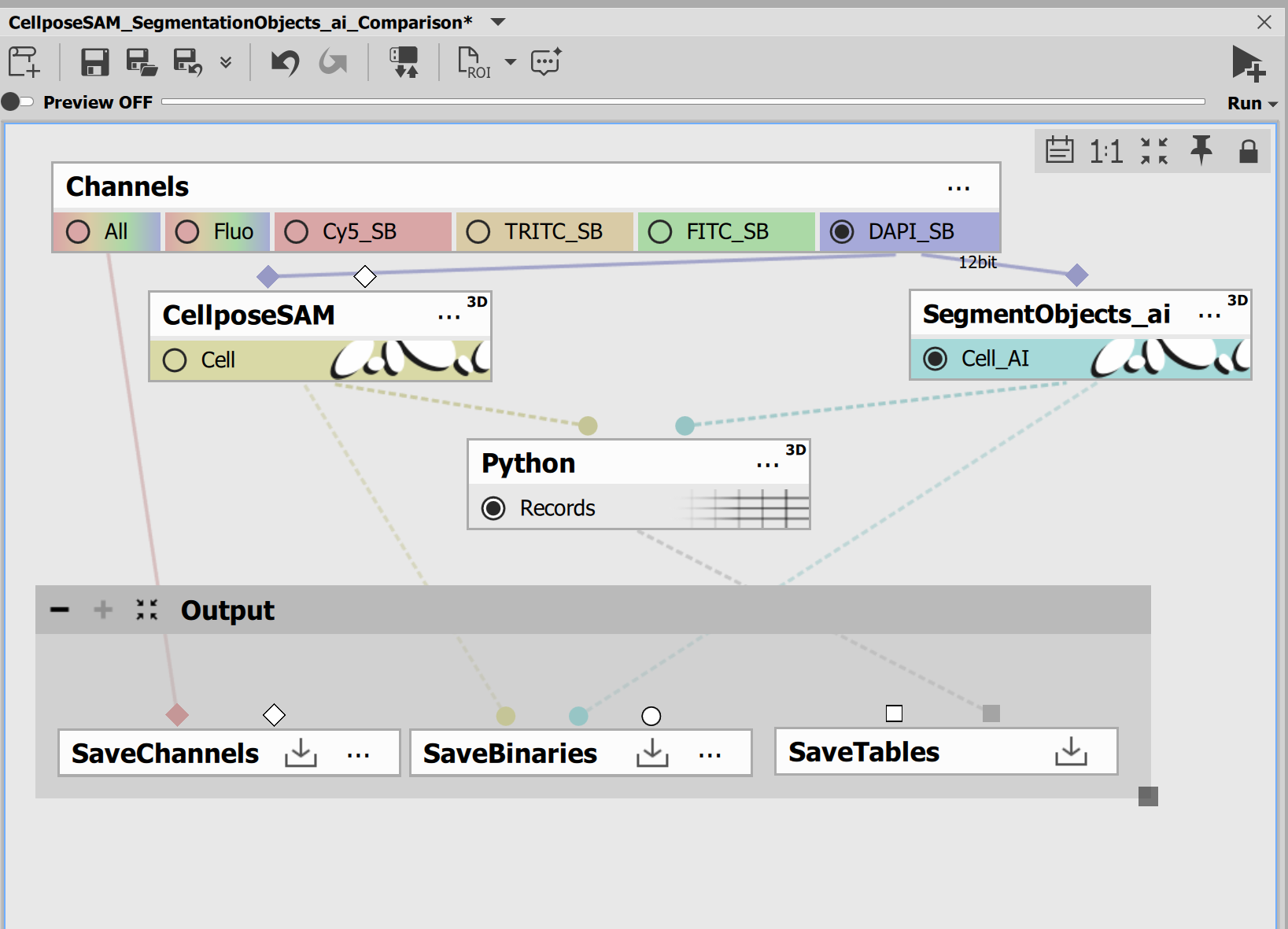
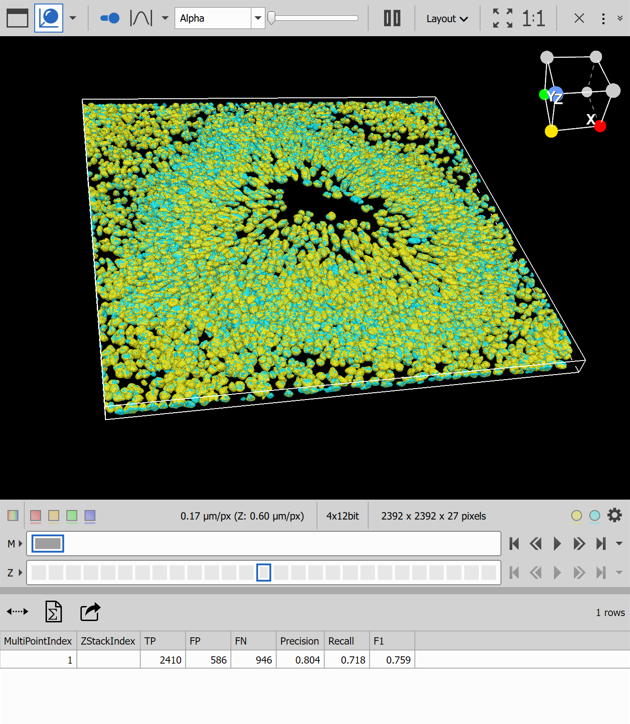
in our case we got this result:
Interpretation
The AI segmentation detected many objects correctly, but it also produced extra objects and missed a number of ground-truth objects.
- True positives (TP): 2,410 — ground-truth objects correctly matched by predictions.
- False positives (FP): 586 — predicted objects that did not match a ground-truth object.
- False negatives (FN): 946 — ground-truth objects that the AI missed.
This produces:
- Precision: 0.804 (80.4%) — about 80% of the predicted objects were correct. Roughly 1 in 5 predictions was a false positive.
- Recall: 0.718 (71.8%) — the AI found about 72% of the ground-truth objects and missed about 28%.
- F1 score: 0.759 (75.9%) — the combined balance between precision and recall.