Measurement
Measurement nodes have typically one binary input and optional intensity inputs. They output one table. All measurements can calculate custom features defined by user equation using other features.
Basic
Field, Volume
The node measures intensity (incl. ratiometric) features of 2D frames.
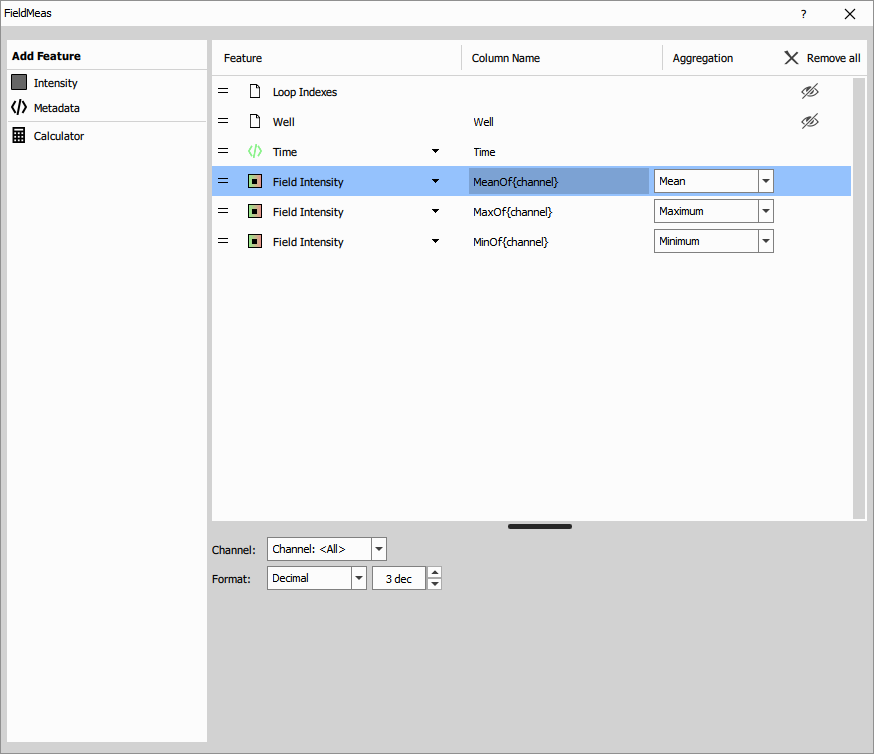
It produces a table where every row corresponds to a field (input A1 - Channel) which can be restricted by an optional mask (input M - Binary).
The columns are the selected measured features:
- loop indexes for book keeping (one-based),
- intensity aggregates intensity and ratio features for whole frame,
- metadata features which can vary per frame and
- custom calculated features that are defined by an equation that uses the above.
Field measurements are typically performed during time or under different condition. For example in Calcium, FRET, FRAP experiments.
Parameters
Object
The node measures object features such as: size, shape, intensity and position of objects (spots, nuclei, cells or animals).
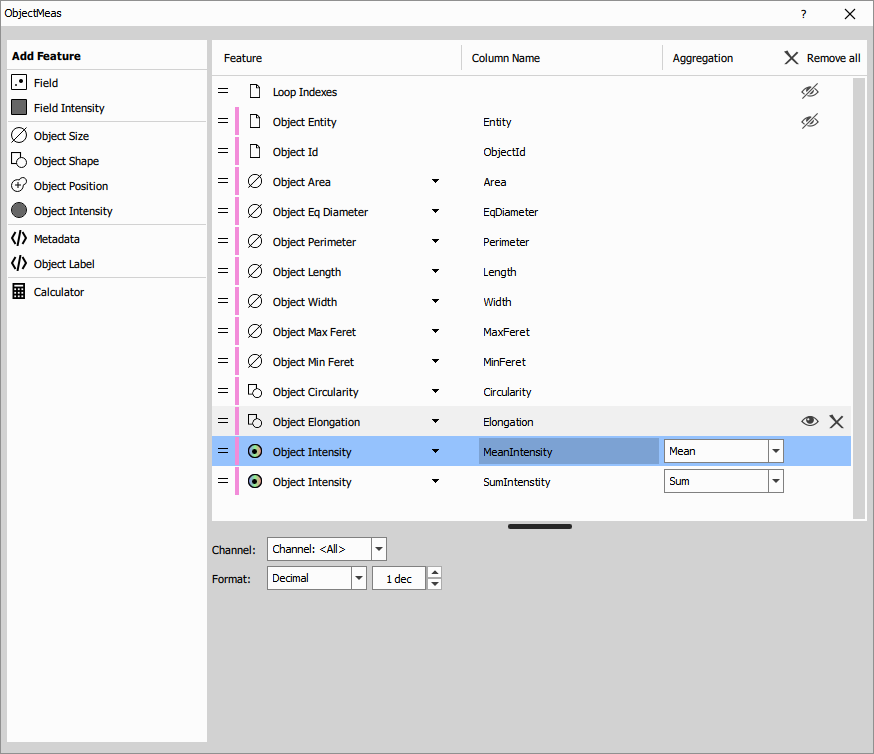
It produces a table where every row corresponds to an object (input A1 - Binary). Intensities are taken from optional channels (input B1, … - Channels).
The columns are the selected measured features:
- loop indexes for frame book keeping (one-based),
- object id and entity for object book keeping,
- field object aggregates per frame such as: Count, Measured area, Area fraction, …,
- field object intensity aggregates like intensity and ratio for whole frame,
- object size features such as Area, Equivalent Diameter, Length, …,
- object shape features such as Circularity, Elongation, Roughness, …
- object position features such as in Frame or on Stage,
- object intensity aggregates per object intensity and ratio,
- metadata features which can vary per frame or whole file and
- custom calculated features that are defined by an equation that uses the above features.
Parameters
Object Count
The node counts object and measures aggregated object features (mean, min, max, standard deviation, etc.) for all objects on the frame.
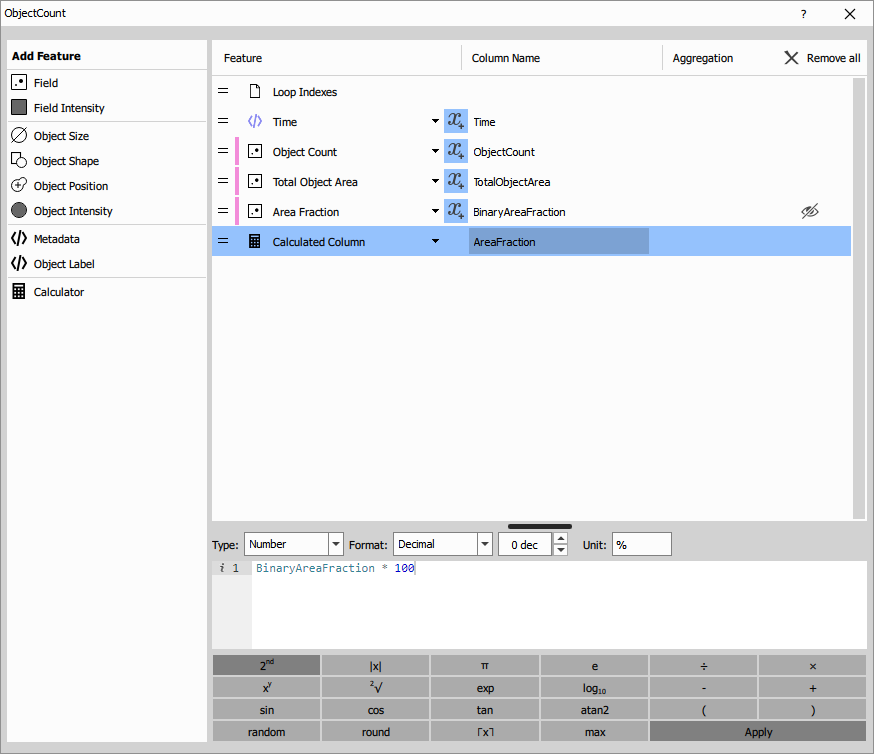
It produces a table where every row corresponds to a field. Multiple Binaries may be connected (input A, … - Binary). Intensities are taken from optional channels (input B1, … - Channels).
The columns are the selected measured features:
- loop indexes for book keeping (one-based),
- object entity for book keeping,
- field object aggregates per frame such as: Count, Measured area, Area fraction, …,
- field object intensity aggregates like intensity and ratio for whole frame,
- object size features such as Area, Equivalent Diameter, Length, …,
- object shape features such as Circularity, Elongation, Roughness, …
- object position features such as in Frame or on Stage,
- object intensity aggregates per object intensity and ratio,
- metadata features which can vary per frame or whole file and
- custom calculated features that are defined by an equation that uses the above features.
The prime use of this node is counting one or multiple binaries – classes of objects.
Parameters
Children
The node measures children object features and aggregates with respect to parent objects. Parent objects features can be measured too.
It produces a table where every row corresponds to a child object (input B - Binary). A child object is inside, touching or in a zone of influence of it’s parent object (input A - Binary). Intensities are taken from optional channels (input C1, … - Channels).
The columns are the selected measured features:
- loop indexes for book keeping (one-based),
- parent object id and entity for book keeping,
- field object aggregates per frame for parent and children such as: Count, Measured area, Area fraction, …,
- field object intensity aggregates like intensity and ratio for whole frame,
- parent object size features such as Area, Equivalent Diameter, Length, …,
- parent object shape features such as Circularity, Elongation, Roughness, …,
- parent object position features in Frame or on Stage,
- parent object intensity aggregate per object intensity and ratio,
- children object and intensity aggregates per parent such as: Count, Area fraction, Intensity and ratio aggregates,
- child object id and entity for book keeping,
- child object size features such as Area, Equivalent Diameter, Length, …,
- child object shape features such as Circularity, Elongation, Roughness, …,
- child object position features in Frame or on Stage,
- child object intensity aggregate per object intensity and ratio,
- metadata features which can vary per frame or whole file and
- custom calculated features that are defined by an equation that uses the above features.
Parameters
Parent
The node measures parent object features and aggregates of its children.
It produces a table where every row corresponds to a parent object (input A - Binary). Children object (input B - Binary) features are aggregated per parent. A child object (input B - Binary) is inside, touching or in a zone of influence of it’s parent object. Intensities are taken from optional channels (input C1, … - Channels).
The columns are the selected measured features:
- loop indexes for book keeping (one-based),
- parent object id and entity for book keeping,
- field object aggregates per frame for parent and children such as: Count, Measured area, Area fraction, …,
- field object intensity aggregates like intensity and ratio for whole frame,
- parent object size features such as Area, Equivalent Diameter, Length, …,
- parent object shape features such as Circularity, Elongation, Roughness, …,
- parent object position features in Frame or on Stage,
- parent object intensity aggregate per object intensity and ratio,
- children object count aggregates per parent,
- children object id and entity aggregates per parent for book keeping,
- children object size aggregates per parent features such as Area, Equivalent Diameter, Length, …,
- children object shape aggregates per parent features such as Circularity, Elongation, Roughness, …,
- children object position aggregates per parent features in Frame or on Stage,
- children object intensity aggregates per parent and child intensity and ratio,
- metadata features which can vary per frame or whole file and
- custom calculated features that are defined by an equation that uses the above features.
Parameters
Cell
The node measures all the object features for the whole cell, nucleus and some on cytoplasm. It can quantify optional spots in all these compartments.
It produces a table where every row corresponds to a cell. The cell is composed of Nucleus and Cell in 1:1 relation. The Cell measurement node must be connected to the Make cell node to ensure this 1:1 relation. The measurement node creates Cytoplasm internally (as binary subtraction Cell - Nucleus) to perform measurements on it.
The columns are the selected measured features:
- loop indexes for book keeping (one-based),
- cell id and entity for book keeping,
- field object aggregates per frame for parent and children such as: Count, Measured area, Area fraction, …,
- field object intensity aggregates like intensity and ratio for whole frame,
- cell size features such as Area, Equivalent Diameter, Length, …,
- cell shape features such as Circularity, Elongation, Roughness, …,
- cell position features in Frame or on Stage,
- cell intensity aggregate per cell of intensity and ratio,
- nucleus size features such as Area, Equivalent Diameter, Length, …,
- nucleus shape features such as Circularity, Elongation, Roughness, …,
- nucleus position features in Frame or on Stage,
- nucleus intensity aggregate per nucleus intensity and ratio,
- limited cytoplasm aggregates such as Pixel Area, Area fraction and Intensity,
- limited spots aggregates per each compartment features such as Count, Pixel Area and Intensity,
- spot size aggregates per cell of features such as Area, Equivalent Diameter, Length, …,
- spot shape aggregates per cell of features such as Circularity, Elongation, Roughness, …,
- spot position aggregates per cell of features in Frame or on Stage,
- spot intensity aggregates per cell of intensity and ratio,
- metadata features which can vary per frame or whole file and
- custom calculated features that are defined by an equation that uses the above features.
Parameters
Estimates
Shift Estimate
Estimate shift between two images
Parameters
SNR Estimate
Estimate image signal-to-noise ratio
Metadata
Global
Retrieve global metadata of channel
Recorded Data
Retrieve all recorded data of channel
Wellplate
Retrieve wellplate information and thumbnails
Parameters
Input
A (Channel)
B1, B2, … (Binary, Optional, Multiple)
Output
- R (Table)
Control
previewMode (Number)
sourceRectSize (Number)
thumbFit (Text)
imgFormat (Text)
predefinedLabels (Text)
thumbMaxSize (Number)
imgQuality (Number)
imgAutocontrast (Number)
imgAutocontrastThrLow (Number)
imgAutocontrastThrHigh (Number)
binFillOpacity (Number)
binStrokeOpacity (Number)
Field pixel values
Histogram
Measure field intensity histogram
Parameters
Pixel Values
Measure all pixel values from the field
Resolution
Image Pair FRC
Estimate resolution using Fourier ring correlation between two independent images
One Image FRC
Estimate resolution using Fourier ring correlation from single image
Parameters
Object pixel values
Histogram
Measure intensity histogram for each object
Parameters
Pixel Values
Measure all pixel values for each object
Profile Line
Measure all pixel values along a line
Distance
Nearest Object, NearestObjDist
Measure distance from each object to its nearest neighbor
Pairwise Distance
Measure distances between objects in two binary layers
Z-stack measurements 3D
Focus criteria
Measure the focus criteria across z-slices and estimate the best focus plane